

Electropolishing is a critical finishing process for achieving the ultra-smooth, hygienic surfaces required in industries like pharmaceuticals, biotechnology, food & beverage, and medical devices. While “frictionless” is a relative term, electropolishing creates a surface with extremely low micro-roughness and minimal surface energy, which is functionally “frictionless” for contaminants, microbes, and fluids.
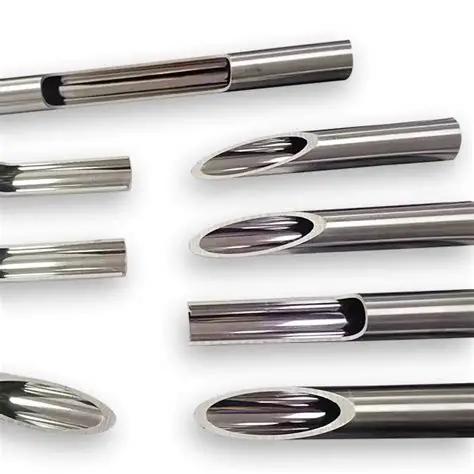
Here’s a detailed breakdown of how it works and why it’s ideal for hygienic applications:
What is Electropolishing?
Electropolishing is an electrochemical process that removes a thin, controlled layer of material (typically 20-40µm) from a metal surface, most commonly austenitic stainless steels (like 304 and 316L). The part acts as the anode (+) in an electrolytic bath (often a mixture of sulfuric and phosphoric acids). When current is applied, metal ions are dissolved from the surface into the electrolyte.
The Two-Stage Smoothing Mechanism
1. Macro-Leveling (Anodic Leveling):
· Current density is higher on peaks (microscopic high points) and edges than in valleys due to closer proximity to the cathode.
· This causes the peaks to dissolve faster than the valleys, leveling the overall surface profile and removing scratches, burrs, and tool marks from manufacturing.
2. Micro-Smoothing (Anodic Brightening):
· At a microscopic level, the surface is a mix of different crystal grains and inclusions.
· Electropolishing preferentially dissolves the less dense, amorphous, or stressed material first, leaving behind a surface dominated by the most stable, compact crystalline structure.
· This process smoothes the surface at a sub-micron level, drastically reducing Surface Roughness (Ra). A mechanically polished surface might have an Ra of 0.5 – 1.0 µm, while an electropolished surface can achieve Ra < 0.25 µm, often as low as 0.1 µm.
Why This Creates a “Hygienic” or “Frictionless” Surface
Direct Comparison: Mechanical Polishing vs. Electropolishing
| Feature | Mechanical Polishing (Abrasive) | Electropolishing (Electrochemical) |
| Surface Profile | Smears and folds metal over peaks and valleys. Can trap impurities. | Removes material from peaks, leveling the surface. No embedded contaminants. |
| Deburring | May not reach internal surfaces or micro-burrs. | Uniformly treats all exposed surfaces, including complex internal geometries. |
| Corrosion Layer | Can create a thin, disturbed, and inconsistent passive layer. | Creates a thick, uniform, and robust chromium oxide passive layer. |
| Contamination Risk | Risk of abrasive media (sand, grit) embedding into the surface. | Chemically clean surface; removes embedded iron and other particulates. |
| Consistency | Operator-dependent; can vary across complex parts. | Highly uniform and repeatable across entire surface area. |
Key Applications
· Pharmaceutical/Biotech: Process vessels, fermenters, chromatography columns, piping (SIP/CIP systems), valve bodies, pump internals.
· Food & Beverage: Mixing tanks, piping for dairy, brewing, and juice lines, fittings.
· Medical Devices: Surgical instruments, implant components, bone reamers, cannulae.
· Semiconductor: High-purity fluid and gas handling components.
Summary
Electropolishing creates a “frictionless” hygienic surface not by making it perfectly smooth in a literal sense, but by:
1. Electrochemically dissolving microscopic peaks and imperfections.
2. Creating a uniform, defect-free surface with minimal anchor points for contaminants.
3. Enhancing the native corrosion-resistant oxide layer.
4. Facilitating perfect drainage and cleaning.
Post time: Dec-16-2025