

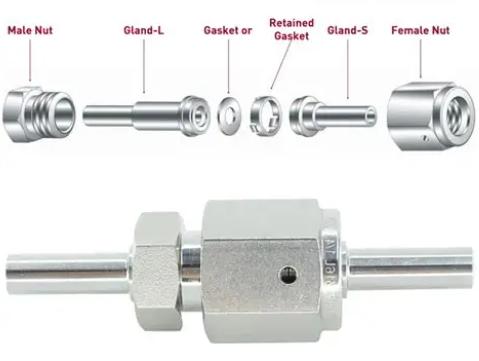
VCR fittings are metal-gasket face-seal connections used from vacuum to positive pressure in semiconductor, high-purity gas, and analytical instrumentation systems. The seal is not made by the threads. Instead, axial force from the nuts compresses a soft metal gasket between two mating glands, causing the gasket to deform plastically and fill microscopic surface imperfections.
Installation: The 1/4 Turn Is Not Universal
Before installation, verify that the tube end is free of dents and scratches, squarely cut, and deburred. Use two wrenches: hold the male nut or body stationary and rotate only the female nut. Do not rotate the male side.
Tightening turns vary by specification and practice. Swagelok-style manufacturer instructions commonly call for finger-tight plus 1/8 turn (45°) for silver-plated stainless steel gaskets. In field practice, 1/4 turn (90°) is often used as a more conservative approach to improve sealing reliability and reduce later leaks. Either way, do not over-tighten; excessive torque can permanently damage the sealing surfaces and create a micro-leak path.
Gasket installation depends on gasket style:
- ▪ Retained/tabbed gasket: clips directly onto the male gland.
- ▪ Side-load gasket: slides in from the side, useful in confined spaces.
- ▪ Non-retained gasket: placed inside the female nut and must sit perfectly flat, or the nut will not seat fully.
A VCR gasket should be replaced every time the fitting is remade.
Gasket Selection: Material Determines Application
The gasket is the consumable sealing element and a key performance variable.
Nickel: Balanced general-purpose choice for high-purity service; helium leak rate can reach 4 × 10⁻¹¹ std cm³/s.
316L stainless steel: Good corrosion resistance, but bare 316L SS gaskets should generally be avoided in inert gas systems because they can cold-weld to mating stainless surfaces.
Silver-plated stainless steel: Recommended for inert gas systems. Prevents cold welding. Typical leak rate is 4 × 10⁻⁹ std cm³/s.
Copper: Soft and seals well, but corrosion resistance is more limited; often replaced by nickel or silver-plated SS in high-purity applications.
Helium Leak Rates: Read the Numbers Correctly
Published VCR helium leak rates are not a single universal value; they depend strongly on gasket type. Common industry test baselines are:
- Silver-plated or copper gaskets: maximum leak rate typically 4 × 10⁻⁹ std cm³/s.
- Unplated nickel, copper, or 316L SS gaskets: maximum leak rate as low as 4 × 10⁻¹¹ std cm³/s.
These numbers should be interpreted as tested upper limits, not as a simple ranking of “better” versus “worse.” The 4 × 10⁻¹¹ std cm³/s value represents a verified capability for that configuration. The looser 4 × 10⁻⁹ std cm³/s rating for silver-plated gaskets reflects a practical balance between sealing performance, cost, and the needs of most high-purity gas systems.
When helium leak testing, use the test port on the female nut where available. Localized testing at the test port is more accurate than external spray-and-sniff scanning and can also help confirm that the gasket is seated correctly.
Bottom Line
VCR reliability depends on three things: correct tightening, the right gasket material, and a correct understanding of the published helium leak rate. A fitting that passes an initial leak check can still develop a micro-leak later if any of these factors is compromised.
For corrosive gases, hydrogen, or unusual temperature/pressure conditions, gasket selection may need further refinement.
Post time: Oct-23-2026