

Why Are UHP Gas Delivery Systems So Critical?
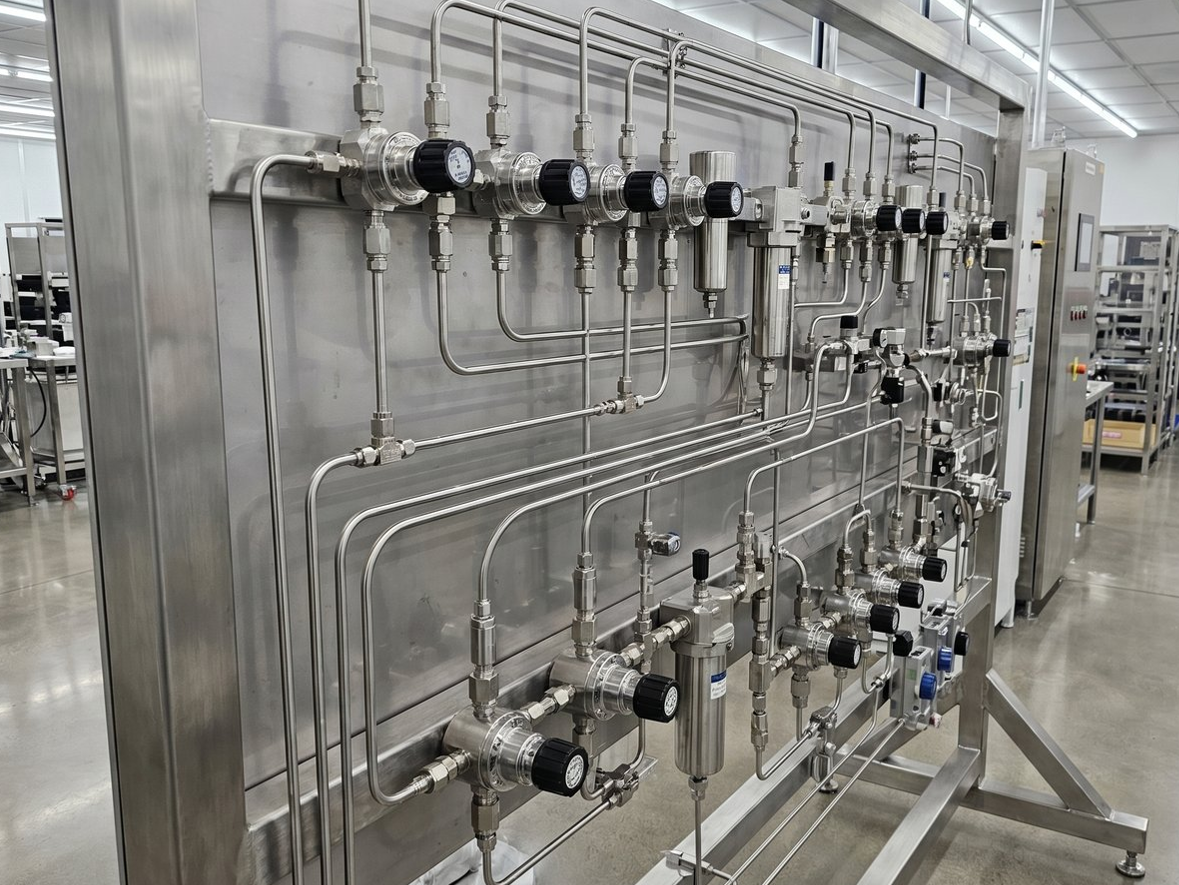
In semiconductor manufacturing—processes like etching, CVD, ion implantation, and lithography—process gases must be ultra‑high purity, typically 99.9999% (6N) or even 99.99999% (7N). Even trace contaminants at the ppb (parts per billion) or ppt (parts per trillion) level—such as moisture or oxygen—can cause fatal defects like gate oxide thinning, metallic voids, or short circuits on wafers, potentially scrapping entire lots.
The mission of a UHP gas delivery system is therefore to transport gases from the source to the process tool without any degradation in purity, preventing both contamination and leakage at every point.
Why Does EP Tubing Become the Backbone of UHP Systems?
EP (Electropolished) tubing is made from stainless steel that undergoes an electrochemical polishing process, yielding a mirror‑like internal surface. This makes it the indispensable “artery” for UHP gas distribution.
Ultimate Cleanliness – Prevention at the Source
EP processing reduces internal surface roughness (Ra) to 0.13 µm – 0.25 µm or even lower. This ultra‑smooth finish eliminates microscopic crevices and adsorption sites, leaving no room for particles, metal ions, or moisture to adhere.
Enhanced Corrosion Resistance – Purity Preservation
The electropolishing step removes surface impurities and forms a chrome‑oxide rich passive layer, significantly improving resistance to corrosive gases like Cl₂, CF₄, and HCl. This prevents pipe wall corrosion that could generate particulates or outgas contamination.
Improved Flow Efficiency & Faster Purge
The smooth inner wall reduces flow resistance and accelerates system purging and gas substitution. In processes requiring rapid gas switching, this shortens cycle times and boosts fab throughput.
Premium Material – The “Crown” Standard
High‑quality EP tubing is manufactured from 316L VIM‑VAR (Vacuum Induction Melting + Vacuum Arc Remelting) stainless steel. This double‑melt process ensures extreme bulk purity of the base metal, which is the fundamental prerequisite for achieving EP’s ultimate performance.
Key Application Scenarios
•
Core Processes – Delivery of high‑purity reactive gases for etching, CVD, ion implantation, and lithography.
•
Specialty Gases – Safe handling of flammable, toxic, or corrosive gases such as SiH₄, PH₃, Cl₂, and BCl₃. For extremely hazardous gases, double‑containment EP tubing is often used (inner tube for gas, outer jacket evacuated or purged with nitrogen for leak monitoring).
•
Critical Hardware – Used in gas distribution panels (VMBs), gas cabinets, and process tool hook‑ups where ultra‑clean internal surfaces are mandatory.
Beyond the Tubing: Other Essentials for a Complete UHP System
To ensure absolute integrity, the system must also incorporate:
•
Fully Automatic Orbital Welding – Performed in ISO Class 5 (Class 100) or better cleanrooms, eliminating manual welding variances and contamination risks.
•
All‑Metal Face‑Seal Fittings – Such as VCR® or W‑Seal types, which rely on metal gaskets for zero‑leak performance.
•
Rigorous Cleaning & Packaging – EP tubes are typically cleaned with high‑purity water, dried, and purged with nitrogen before being double‑bagged in cleanroom packaging to preserve their “as‑shipped” purity until installation.
EP tubing is not merely a pipe—it is the first line of defense in semiconductor gas delivery. Its ultra‑smooth surface, superior corrosion resistance, and premium material purity directly impact wafer yield, device reliability, and overall fab profitability. In the world of sub‑5nm nodes and ever‑tighter defect budgets, EP tubing is not optional—it is foundational.
Post time: Aug-05-2026